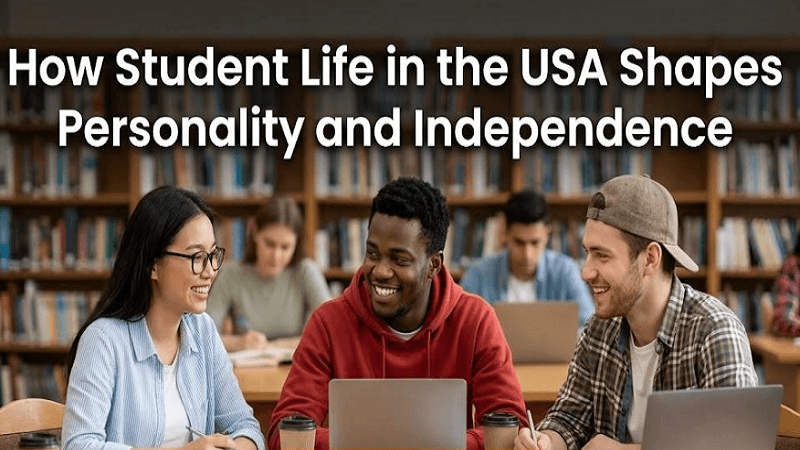
The transition from high school to university in the United States is more than an academic milestone; it is a profound cultural rite of passage. For students navigating the American education system, the journey from the structured environment of a family home to the autonomy of a college campus acts as a crucible for personality development.
As we look toward the 2026-2027 academic cycle, the demands on students have evolved. Success is no longer just about passing exams; it is about the holistic development of a “Growth Mindset” and the ability to leverage modern tools to manage a complex lifestyle. This evolution is driven by a unique combination of social expectations, diverse community engagement, and the necessity of self-reliance.
1. The Shift from Supervision to Self-Governance
In high school, a student’s schedule is largely dictated by external forces: parents, teachers, and rigid bell schedules. The shift to higher education in the USA removes these guardrails abruptly, placing the burden of “Executive Function” squarely on the student.
The primary driver of independence is the management of “unstructured time.” In a typical US university setting, a student might only spend 15 to 18 hours a week in a classroom. The remaining 150 hours are a blank canvas. Students must decide when to eat, how to prioritize a heavy syllabus, and how to balance social life without a curfew. To manage the sudden influx of complex assignments, some students initially look for an online essay writing service at Myassignmenthelp.com to understand academic standards before mastering the workload themselves.
Those who master this environment early often emerge with a high degree of conscientiousness—a personality trait characterized by being organized, dependable, and disciplined. To build this trait, students often adopt specific productivity frameworks, such as “Time-Blocking” or the “Pomodoro Technique,” which help transform overwhelming semesters into manageable daily tasks.
2. The Melting Pot Effect: Expanding Emotional Intelligence
American campuses are renowned for their diversity. Moving away from one’s hometown to a university often means living and studying with people from entirely different socioeconomic, racial, and international backgrounds. The journey often begins months before arrival, where many applicants utilize a college admission essay writing service to effectively communicate their unique cultural background to admissions officers.
This exposure is a catalyst for “Openness to Experience.” When students engage with perspectives that challenge their own, it fosters cognitive flexibility and empathy. Navigating roommates from different walks of life—often in the close quarters of a freshman dorm—requires conflict resolution and negotiation skills that cannot be taught in a textbook.
By the time an American student reaches their senior year, their “Social Intelligence”—the ability to navigate complex social environments—is significantly heightened. They learn that collaboration is not just a soft skill but a survival mechanism in a globalized world.
3. The “Hustle Culture” and Financial Literacy
Student life in the USA is increasingly defined by the “student-worker” identity. Whether it is an on-campus job at the library, a Federal Work-Study position, or a summer internship in a competitive city like New York or Chicago, American students are encouraged to seek financial independence early.
Managing a part-time job alongside a full-time credit load instills a pragmatic edge to one’s personality. Students learn:
- The Value of a Dollar: Balancing a meal plan against personal spending.
- Tax Literacy: Understanding W-2s and the basics of the US tax system.
- Professionalism: Learning how to communicate with supervisors and meet deadlines in a non-academic setting.
4. Extracurriculars and the Leadership Pipeline
The USA education system places a heavy emphasis on “The Holistic Student.” Participation in Greek life, student government, varsity sports, or niche interest clubs is not just about fun—it is about leadership.
Taking on a role as a club treasurer or a team captain allows students to practice “Agentic Behavior”—taking initiative to influence their environment. These experiences reduce “Neuroticism” (emotional instability) by building self-efficacy. When a student successfully organizes a campus event or leads a volunteer drive, they internalize the belief that they can effect change.
5. Overcoming the “Sophomore Slump”: Building Resilience
Academic life is rarely a linear path of success. Many students face the “Sophomore Slump”—a period in the second year where the initial excitement of college fades, and the weight of major-specific coursework begins to feel heavy.
In the USA, the availability of resources—such as writing centers, counseling services, and peer tutoring—encourages “help-seeking” behavior. Learning when and how to ask for assistance is a sophisticated form of independence. It acknowledges that true autonomy isn’t about doing everything alone, but about managing resources effectively to achieve a goal.
6. The Role of Technology and Strategic Delegation
Today’s students are “Digital Natives,” and their independence is now intertwined with tech proficiency. For the 2026-2027 academic year, being “tech-savvy” means more than just using a laptop; it means mastering “Digital Literacy” and AI-human collaboration.
From using AI-driven research tools to managing digital portfolios, students must be agile. However, the sheer volume of assignments—ranging from complex coding projects to 20-page research papers—can be overwhelming. This is where strategic delegation becomes a key trait of the successful modern professional.
Just as a CEO delegates specialized tasks to experts, savvy students recognize when to seek professional assignment help for highly technical or time-intensive projects. This allows them to focus on “Deep Learning” in their core subjects rather than just “getting through” the workload. In the professional world, leaders manage resources to ensure the best outcome; university is where students first learn this vital management skill.
7. Evidence-Based Study Techniques: Deep Work and Active Recall
To thrive in the competitive USA academic landscape, students are increasingly turning to evidence-based learning methods. Transitioning away from passive reading, successful students employ “Active Recall” and “Spaced Repetition” to move information into long-term memory.
Furthermore, the concept of “Deep Work”—the ability to focus without distraction on a cognitively demanding task—has become a cornerstone of student productivity. By carving out “Deep Work” sessions, students can complete intense assignments in half the time, leaving more room for the personal development and social engagement that defines the American college experience.
8. Cultivating a Global Perspective through Internal Migration
Living as a student in the USA often involves “Internal Migration”—moving across states or time zones. For a student from California attending school in Massachusetts, the cultural shift can be as significant as moving to a new country.
This distance from the primary support network of the family forces a rapid maturation. Students must handle their own healthcare, navigate local laws, and build a “chosen family” of friends and mentors. This journey transforms a student from a “dependent” to a “citizen.”
9. Career Readiness and the Transition to the Workforce
The final stage of the US student experience is the pivot toward career readiness. By their junior and senior years, students are expected to have mastered the art of the “Elevator Pitch” and the digital networking skills required on platforms like LinkedIn.
The independence gained in the first two years now manifests as professional confidence. Students who have balanced extracurriculars, part-time work, and rigorous academics possess the “Soft Skills”—communication, adaptability, and problem-solving—that US recruiters value more than a high GPA alone.
10. Mastering Digital Skills
As we look forward, the integration of Digital Skills is no longer optional. Students are now expected to be proficient in:
- Ethical AI Collaboration: Learning how to use Agentic AI and LLMs to brainstorm and structure research while maintaining academic integrity.
- Data Analysis: Using tools to interpret academic research and market trends.
- Programming Basics: Even for non-STEM majors, understanding the logic of code is essential for the modern workforce.
Frequently Asked Questions
Q.1 How does the US college system help students become more independent?
The US system encourages independence through “unstructured time” and residential life. By moving away from home, students must manage their own schedules, finances, and social conflicts, which builds essential executive function and conscientiousness.
Q.2 What is the “Sophomore Slump” and how can students overcome it?
The Sophomore Slump is a period of decreased motivation often occurring in the second year. To overcome it, students are encouraged to utilize campus resources like academic counseling, writing centers, and peer tutoring. Learning to ask for help is a key step in developing mature autonomy.
Q.3 Why are extracurricular activities so important in the USA?
In the American education system, extracurriculars are seen as a “leadership pipeline.” Roles in student government or clubs allow students to practice taking initiative (agentic behavior) and build self-efficacy, which directly translates to professional success.
Q.4 How can students balance a part-time job with full-time studies?
Successful students use productivity frameworks like “Time-Blocking” and the “Pomodoro Technique.” Many also lean on academic support services and specialized assignment help to manage high workloads, ensuring they can gain professional experience without sacrificing their GPA.
Q.5 What digital skills are most important for the 2026-2027 academic year?
Beyond basic computer literacy, students should focus on AI collaboration, data analysis, and remote communication tools. Mastery of these skills ensures that students are prepared for both advanced academic research and the modern, tech-driven workforce.
Conclusion: The Lasting Impact
The four to six years spent as a student in the USA do more than grant a degree; they curate a personality. The American student emerges as a blend of several key traits: Adaptability, Resilience, and Autonomy.
As students look toward the future, the focus remains on balancing these personal developments with technical excellence. By embracing both the challenges of campus life and the available support systems, the modern student is well-equipped to lead in an increasingly complex world.
For those looking to maximize their academic potential while focusing on personal growth, utilizing expert guidance and specialized tools is the smartest way to navigate the rigorous demands of higher education today. Whether it is through a writing center, a mentor, or professional academic support, taking control of one’s academic journey is the ultimate sign of independence.
About the Author – Drake Miller
I am a dedicated blog author, known for creating insightful and student-focused academic content. He specializes in topics related to assignment writing, study strategies, and educational trends. With a clear and practical writing style, Drake aims to simplify complex concepts, helping students improve their understanding and achieve better academic results with confidence.