
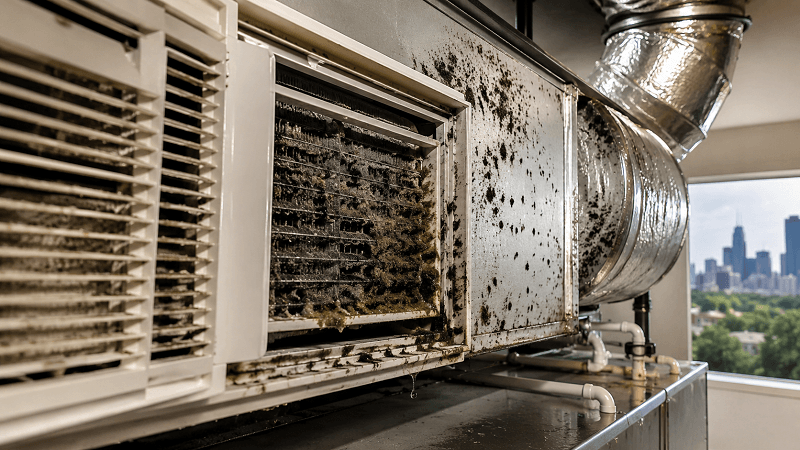
Houston’s climate breeds mold. The city averages humidity levels above 70% for much of the year, and that moisture doesn’t stay outside; it finds its way into your home’s air system. Once it does, mold spores have almost everything they need to multiply.
Knowing what causes mold in Houston HVAC systems matters. Catching a problem early beats facing an expensive remediation job that could’ve been prevented.
High Indoor Humidity and Condensation Buildup
The health risks of mold in home HVAC systems range from mild respiratory irritation to serious conditions, particularly for children, the elderly, and anyone with asthma or allergies. In Houston, here’s the thing: your HVAC system handles enormous amounts of humid air every single day. Each time warm, moisture-heavy air passes over cold evaporator coils, condensation forms. That water has to go somewhere, and if your drain pan or condensate line is blocked, even partially, moisture pools right inside the unit. A thin layer of standing water in a dark, enclosed space? That’s mold heaven.
Most Houston homeowners don’t realize this. Condensation problems don’t require a broken system. A properly functioning unit can still accumulate enough moisture to support mold growth if the surrounding air is humid enough and airflow gets restricted even slightly.
Dirty or Clogged Air Filters
Your air filter does more than trap dust; it controls airflow across the entire system. A clogged filter creates a chain reaction that directly supports mold growth inside your ducts and air handler. In Houston’s climate, filters get saturated faster because the air itself carries more particulate matter along with humidity.
A filter that’s overdue for replacement restricts airflow over the evaporator coil. Less airflow means the coil stays colder longer, which accelerates condensation. At the same time, a dirty filter becomes a food source. Mold spores feed on the organic debris trapped in filter media; from there, spores spread into the duct system every time the blower runs. The fix sounds simple, but the schedule is critical. In Houston, most homes need filter replacements every 30 to 45 days during peak cooling season, not the 90-day interval printed on most filter packaging. That packaging was written for average climates. Houston isn’t average.
Poor Ventilation in the Duct System
Poor ventilation inside an HVAC system refers to imbalances between supply and return airflow that leave stagnant pockets of moist air sitting inside ductwork for hours. Houston homes built before the 1990s frequently have duct layouts never designed for modern air conditioning loads. Older flex ducts sag, kink, or separate at joints, creating dead zones where humid air stalls. Mold spores already in the system settle into those zones and grow undisturbed.
And even newer construction can develop ventilation problems. Return vents blocked by furniture, rooms sealed off from the main living area, or bathroom and kitchen exhaust fans venting back into attic space rather than outside all contribute. An HVAC system that can’t move air freely through every part of the duct network will struggle with moisture accumulation; it doesn’t matter how new the equipment is or how often you change the filter.
Leaky or Improperly Insulated Ducts
Duct leaks are one of the most overlooked causes of mold growth in Houston HVAC systems. A gap or disconnected joint in ductwork running through a hot attic allows warm, humid attic air to mix directly with cold, conditioned air inside the duct. The temperature difference causes immediate condensation on the interior duct surface. In Houston, attic temperatures regularly exceed 140 degrees Fahrenheit in summer; the air leaking in carries an enormous moisture load.
Insulation problems make things worse. Ducts that aren’t insulated to the right R-value for Houston’s climate develop condensation on their outer surfaces. That moisture soaks into surrounding materials, attic insulation, wood framing, drywall, and mold follows. A professional duct inspection can identify gaps, separated connections, and insulation deficiencies before they turn into a full mold problem. Most homeowners have no reason to check their attic ductwork routinely, which is exactly why these leaks tend to go unnoticed for years.
Infrequent HVAC Maintenance
Skipping annual HVAC maintenance is one of the fastest ways to create mold-friendly conditions inside your system. Routine maintenance covers several things that directly prevent mold:
- Cleaning evaporator coils, which collect dust and biological material that mold feeds on
- Flushing the condensate drain line to prevent clogs and standing water
- Inspecting the drain pan for cracks or corrosion that allow moisture to escape into surrounding areas
- Checking refrigerant levels, since low refrigerant causes coils to freeze and then thaw repeatedly, creating excess moisture
- Clearing debris from the air handler cabinet and blower assembly
In Houston, the HVAC system runs for 8 to 10 months out of the year. That’s a much longer operating season than most of the country. A system serviced once a year in Houston accumulates far more wear and biological buildup than a system in a northern climate on the same schedule. But here’s the truth: annual maintenance is a floor, not a ceiling. Many Houston homeowners benefit from a mid-season inspection, particularly before the most demanding stretch of summer heat.
Conclusion
The causes of mold growth in Houston HVAC systems all connect back to one underlying factor: moisture that doesn’t have a clear path out. High humidity, restricted airflow, duct leaks, dirty filters, and deferred maintenance each create the conditions mold needs to take hold. Addressing any one of these issues reduces risk. Address all of them through consistent filter changes, professional maintenance, and periodic duct inspections, and you’ll keep your HVAC system dry, clean, and functioning the way it should.