
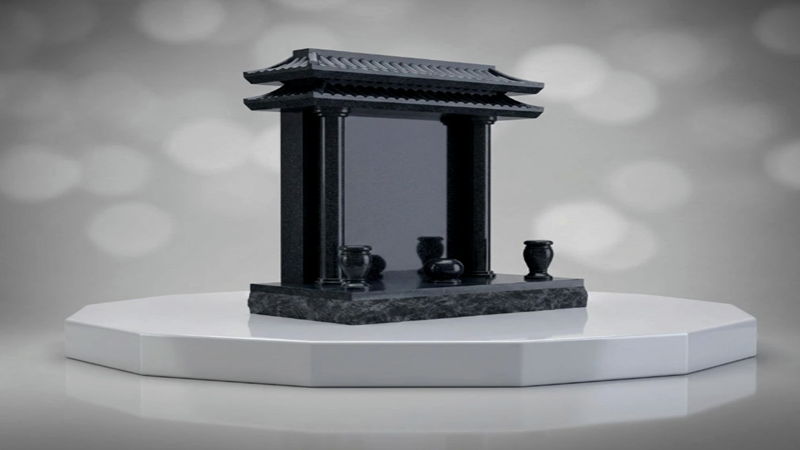
Ask a monument production manager which category puts the most pressure on a facility and the answer is rarely the largest stones or the most expensive ones. It is the Asian-style memorial — a category that combines multi-axis profile cutting, bilingual typography, specific color sourcing, and a calendar of cultural deadlines that does not move for anyone’s production backlog.
The American market for this work has grown steadily for two decades, tracking the growth of Chinese, Korean, Vietnamese, and Japanese American communities in California, Texas, New York, New Jersey, Washington, and Illinois. Funeral homes and cemeteries serving those communities order through wholesale channels in volume, and individual families order direct. What both groups discover is the same: not every producer can actually make these pieces well, and the difference shows immediately.
The Profile Challenge
The defining technical challenge of the asian memorial headstone is the profile. Pagoda rooflines, tiered shoulders, temple-arch silhouettes — these are compound curves cut into dense granite, and they cannot be approximated. A roof tier that is slightly asymmetric reads as wrong to anyone raised with the architectural reference, the way a crooked steeple would read to anyone else. Producing the profile correctly requires multi-axis CNC contour cutting followed by hand finishing on the curved surfaces, because polish quality on a compound curve is where machine work alone falls short. Facilities without that equipment chain either decline the work or deliver pieces that disappoint.
Typography and Bilingual Inscription
Typography is the second pressure point. Most Asian-style memorials carry inscriptions in two scripts — Chinese characters and English, Korean hangul and English, Vietnamese with full diacritics and English — and each script has its own typographic logic. Chinese characters engraved at the wrong stroke weight become illegible at distance; hangul spacing follows rules that a Latin-alphabet typesetter will get wrong by instinct; Vietnamese diacritics are small marks that demand engraving precision at a scale where sandblast stencils are unforgiving. Production teams that handle bilingual layout regularly develop proofing standards specifically for it. Families reviewing a design proof should look closely at the non-English script first, because that is where errors hide from an English-speaking design reviewer.
Color Sourcing and Material Selection
Color sourcing is the third. Red granite carries specific meaning in Chinese memorial tradition — the color of life, fortune, and continuing care rather than mourning — and demand for Indian Red, Indian Aurora, and the warm Finnish reds is concentrated in this category. Quarry-direct supply matters here in a way it does not for standard grey markers: red granite batches vary noticeably between quarry sections, and a producer assembling a companion set or a family plot over several years needs batch consistency that brokers cannot promise. Direct supply relationships with quarries in India and Finland, with density and color verification at intake, are how that consistency is maintained.
The Cultural Calendar and Production Deadlines
The demand calendar is the operational reality nobody outside the trade sees. Qingming, the grave-sweeping observance in early April, concentrates Chinese American cemetery visits into a two-week window — and families planning a new memorial want it installed before the festival, not after. Chuseok in the autumn creates a parallel deadline for Korean American families. Death anniversaries observed on the lunar calendar add individual deadlines throughout the year. A producer serving these communities learns to treat the cultural calendar as a production constraint with no flexibility, because being two weeks late on a Qingming installation is not a minor service failure. It is a missed year.
Columbarium and Cremation Work
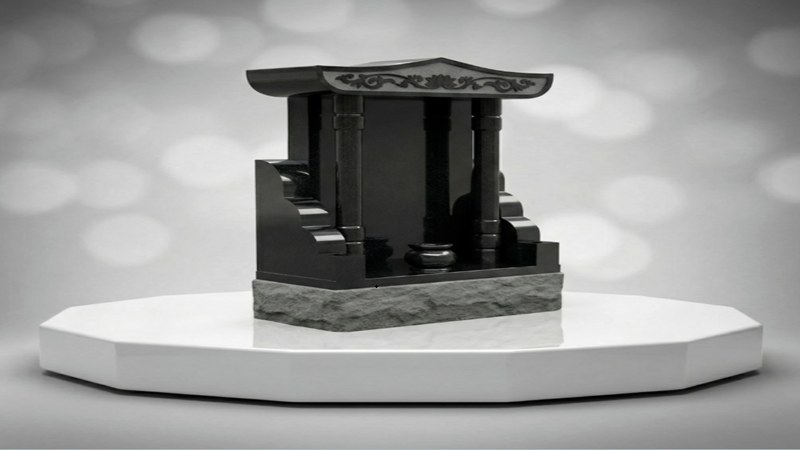
Columbarium and cremation work has become the fastest-growing segment within the category. Cremation rates in East and Southeast Asian American communities run well above the national average, reflecting both tradition and practice in countries of origin, and the memorial formats follow: columbarium niche plaques in granite and bronze, compact upright monuments for cremation gardens, family columbarium structures with multiple niches under a single carved roofline. The technical demands carry over — bilingual engraving at small niche-plaque scale is harder, not easier, than at monument scale.
B2B Ordering Patterns and Consistency
What B2B partners in this category order most consistently tells its own story. Funeral homes in the San Gabriel Valley, in Houston’s Asiatown, in Flushing and Edison and the Seattle suburbs reorder the same core configurations: red granite uprights with pagoda profiles, companion sets with central shared panels, niche plaques in matched batches. The reorder pattern exists because the communities they serve know exactly what a correct piece looks like, and a supplier who delivers correct pieces keeps the account.
Practical Checklist for Individual Families
For individual families, the practical checklist is short. Confirm the producer has actually made the profile being ordered — ask to see production photographs of completed pieces, not renders. Review the non-English inscription with a family member fluent in the script before approving the proof. Confirm the granite color from a physical sample or a verified batch photograph, particularly for reds. And confirm the installation date against the cultural calendar that matters to the family, with margin.
Design Tools and Long-Distance Coordination
The design tools have made the long-distance version of this process workable in a way it was not a decade ago. A 3D proof rendered on the actual selected granite shows the bilingual layout, the profile, and the color together; the AR view places the finished piece at true scale through a phone camera. Families coordinating decisions across continents — children in California, elders reviewing the same file from Taipei or Seoul — approve designs together now without anyone traveling.
Pricing and Payment Terms
Pricing in the category follows material volume and profile complexity rather than any cultural premium. Compact uprights with standard profiles begin at the same entry points as the broader catalog, with pagoda and shrine profiles scaling by cutting time and stone mass. Veterans receive 30% off with full payment, police officers and first responders 25%, and in-house 0% financing runs to twelve months with no background credit check — terms that apply across the catalog without exception.
H Stones Services and Availability
H Stones produces the full Asian-style range — pagoda uprights, arch and shrine profiles, companion sets, columbarium plaques — in more than 40 granite types including the full red spectrum, with bilingual proofing, six-stage quality inspection, and quarry-direct sourcing. Fourteen showrooms across eight states serve walk-in consultations from Sacramento and Glendale to Houston, and the complete catalog with transparent pricing and the 3D and AR design tools is at hstones.com.