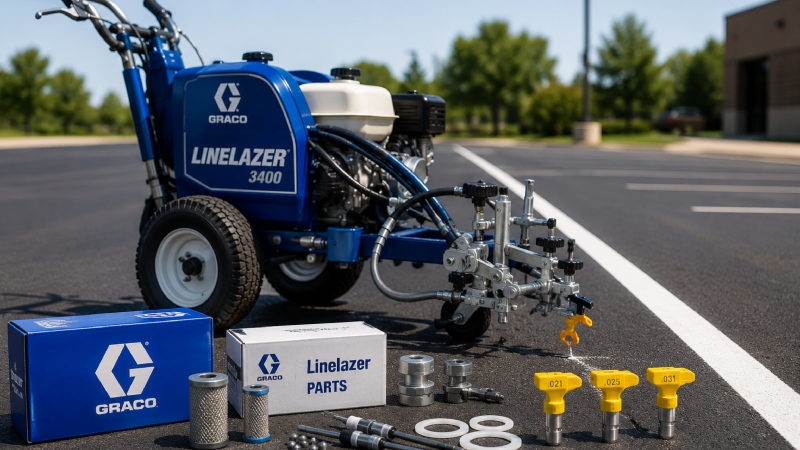
Line striping runs on a different rhythm than most painting work — long, continuous passes, tight schedules, and very little tolerance for downtime mid-lot. A crew that shows up to stripe a parking lot and loses an hour to a clogged tip or a failed valve isn’t just losing that hour; they’re often losing the daylight window the job was scheduled around. Knowing which graco linelazer 3400 parts actually fail first, and keeping those specific items on the truck, is what separates a crew that finishes on schedule from one that doesn’t and has to explain the delay to a property manager.
What the LineLazer 3400 Is Built to Do
Graco designed the LineLazer 3400 as a self-propelled airless striper for continuous, high-volume line work, including parking lots, roadways, warehouse floors, and athletic courts. Unlike a handheld sprayer doing intermittent passes, a striper runs its pump and tips under sustained, continuous flow for extended stretches, which changes the wear pattern significantly compared to project-based spraying. Parts that might last a full season on a homeowner sprayer can wear through in weeks under striping conditions.
The Parts That Fail First Under Striping Conditions
- Tips — striping tips see continuous flow rather than intermittent bursts, and they wear measurably faster than tips used for general painting; most crews budget for tip replacement far more frequently than occasional users would expect
- Tip guards and gun assemblies — the mechanical wear from constant on/off cycling on a striping gun is significant, and a worn gun assembly shows up as an inconsistent line width before it shows up as an outright failure
- Filters — line striping paint often carries more debris and pigment load than standard latex, which means filters clog faster and need more frequent inspection than on a typical painting job
- Pump seals and packings — the sustained-flow nature of striping work puts more cumulative wear on packings over a given time period than stop-start painting does
Building a Truck Stock That Actually Prevents Downtime
The difference between a crew that handles a mid-job part failure in five minutes and one that loses the rest of the day usually depends on whether the crew already carries the needed part on the truck or has to order it.For LineLazer 3400 operations, a sensible baseline stock includes multiple spare tips (striping tips are consumable enough that “one spare” isn’t really enough), a spare gun filter set, and at least one spare set of pump packings for crews running the machine at high volume across multiple jobs per week.
Crews that stripe daily or near-daily tend to build a tighter replacement schedule than the manufacturer’s general guidance suggests — not because the parts are failing early, but because the actual duty cycle is heavier than what general guidance assumes. Tracking your own wear pattern over a few months and adjusting your stock accordingly tends to be more accurate than following a generic interval.
Diagnosing Line Width Problems on the Job
A line that’s inconsistent in width or fading at the edges is almost always a tip issue rather than a pump issue — worn tips widen their spray pattern gradually, which is easy to miss day-to-day until it’s suddenly obvious on a finished lot. Checking tip condition at the start of each job, not just when a problem appears, catches this before it becomes a redo that eats into the crew’s margin.
A line that starts strong and then thins or breaks up partway through a pass points more toward a filter or pressure issue — often a partially clogged filter restricting flow just enough to show up on longer continuous runs, even though it wouldn’t be obvious on shorter test sprays.
Cleanup Between Jobs
Striping paint tends to be higher-solids than standard coatings, which makes thorough flushing between jobs even more important than it is for general painting work. If you don’t fully flush a pump after a striping job, buildup is more likely to develop in the packings and valves than in a pump you use with thinner latex paint. The same PowerFlush-style process works, but you should run it a little longer and make sure the flush water runs completely clear before you finish.
Keeping the LineLazer Ready for the Next Job
For crews running a LineLazer 3400, parts strategy isn’t really about avoiding wear — sustained high-flow striping work wears components faster than general painting, full stop. The strategy that actually works is knowing which parts wear fastest, keeping realistic stock of those specific items on the truck, and pairing them with the right graco spray gun parts so gun-side wear doesn’t catch you off guard mid-lot. That combination is what keeps a crew on schedule instead of explaining a delay to a client.
Frequently Asked Questions
How often should striping tips be replaced under regular use?
It depends heavily on volume, but crews running the LineLazer frequently often replace tips more often than general painting guidance would suggest — tracking your own line-width consistency over time is the most reliable signal.
Why does striping paint clog filters faster than standard latex?
Striping coatings typically carry a higher solids and pigment load, which means more material is passing through the filter per hour of continuous use compared to intermittent painting.
Is a line that fades mid-pass a pump problem or a filter problem?
More often a filter or pressure issue than a pump failure — a partially restricted filter can hold up fine on short test passes but show its limits on longer continuous runs.
Does the LineLazer 3400 need a different flush routine than a standard sprayer?
The process is similar, but because striping paint tends to be higher-solids, running the flush a little longer and confirming the water runs fully clear matters more than it does with standard latex.