
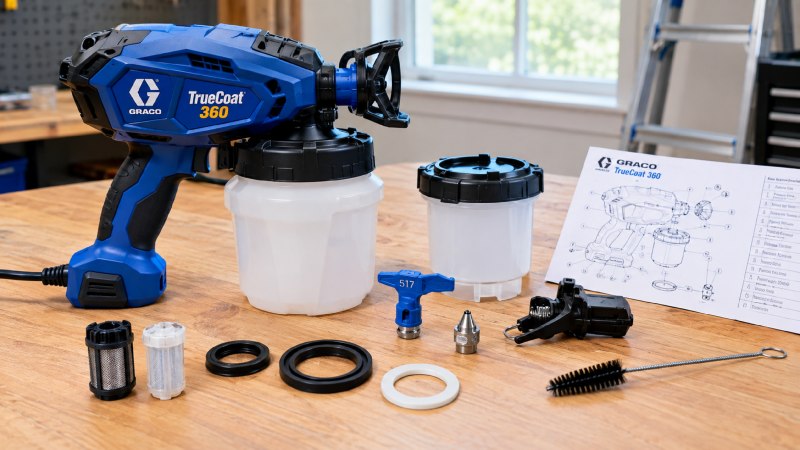
The TrueCoat 360 earned its reputation as one of the simplest airless sprayers to own, largely because its handheld, cup-fed design has fewer points of failure than a full stand-mounted unit. That simplicity doesn’t mean zero maintenance, though — and knowing which graco truecoat 360 parts wear first keeps that reputation for easy ownership intact instead of turning into a mid-project surprise.
Why the TrueCoat 360 Wears Differently Than Larger Sprayers
Unlike bucket-fed Magnum models, the TrueCoat 360 pulls from an attached cup rather than drawing through a long suction tube, which changes its wear pattern in a few meaningful ways. There’s no suction tube to wear out or mismatch, but the trade-off is more frequent refilling on larger jobs and a stronger dependence on the reversible tip staying clean, since there’s no separate inline filter buffering debris the way there is on some larger units.
The Parts That Wear First
- The reversible spray tip — the single most replaced component; a widening or uneven pattern is the clearest sign it needs swapping
- The cup seal and lid gasket — wear with repeated use and are a common source of minor leaks around the cup connection point
- The trigger and valve assembly — sees constant mechanical cycling and eventually needs attention if the trigger starts feeling loose or inconsistent
- Internal filters — smaller and less obvious than on bucket-fed models, but still worth checking when spray performance drops
Diagnosing Common TrueCoat 360 Issues
- Weak or sputtering spray → check the tip first; reversing or replacing it resolves the majority of these cases
- Leaking around the cup → check the cup seal and lid gasket before assuming a bigger problem
- Inconsistent trigger feel → often early wear in the valve assembly, worth addressing before it fails outright mid-job
- Reduced pressure overall → less common on this model, but worth checking the motor housing seal if tip and filter checks don’t resolve it
Cleaning: The Habit That Matters Most on This Model
Because the TrueCoat 360’s design has fewer components than a bucket-fed sprayer, thorough cleaning after every use matters even more — there’s less buffer to hide behind if paint dries somewhere it shouldn’t. Flushing the cup and tip immediately after each session, rather than letting paint sit even briefly, is the single biggest factor in how long the unit’s seals and trigger assembly last.
Reading the Parts Diagram
The TrueCoat 360’s parts layout is simpler than a full Magnum-series diagram, which makes it one of the easier Graco manuals to work from once you know the basic structure. The graco truecoat 360 parts diagram breaks the unit into just a few major sections — tip and cup assembly, trigger and valve, and motor housing — so identifying the right component for a given symptom takes far less cross-referencing than on a larger contractor-grade machine.
Building a Small, Sensible Parts Stock
- A spare reversible tip — the most commonly needed replacement by a wide margin
- A spare cup seal and lid gasket
- Pump Armor or equivalent storage fluid for gaps longer than a few days
This is a short list relative to a full contractor-grade machine, which is part of why the TrueCoat 360 remains such a low-maintenance option for owners who want reliable spray results without a large parts inventory to manage.
The Bottom Line
The TrueCoat 360’s simplicity is a genuine advantage, but it’s not maintenance-free. A spare tip, a spare seal, and a consistent cleaning habit are enough to keep it performing reliably for years — and knowing the handful of parts that actually wear means never being caught off guard mid-project.
Frequently Asked Questions
How often does the TrueCoat 360’s tip need replacing?
It depends on usage frequency, but a widening or uneven spray pattern is the clearest sign it’s time — keeping one spare on hand avoids a mid-job interruption.
Is the TrueCoat 360 harder to clean than bucket-fed models?
Generally easier, thanks to its simpler cup-fed design, but thorough cleaning after every use matters just as much since there are fewer components to buffer dried paint.
What causes leaking around the cup on this model?
Usually a worn cup seal or lid gasket — an inexpensive and quick fix once identified.
Can the TrueCoat 360 handle thicker coatings like the larger Magnum models?
It’s built more for lighter-duty use and finer finishes; thicker coatings are generally better suited to a bucket-fed Magnum-series sprayer.