
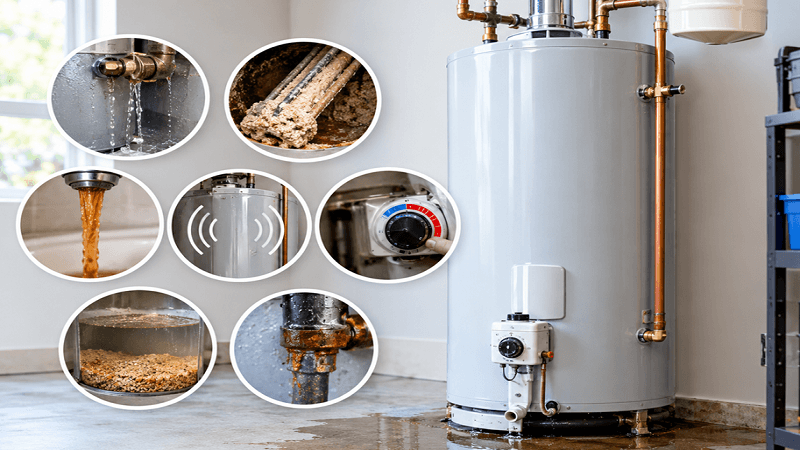
Your water heater almost always warns you before it quits, and the biggest clues are banging sounds, puddles near the tank, and discolored water. Spot these water heater failure signs early, and you can schedule a repair instead of facing a cold shower and a flooded utility room.
This guide is written to help you recognize each warning sign and understand what causes it. As you read, we will show you what to check at home, which problems you can monitor, and when a professional inspection protects you from a flooded floor and a surprise repair bill.
Early Red Flags You Can Hear or See
- When you hear banging, popping, or rumbling inside the tank, you are listening to classic water heater noises, which we trace to hardened minerals trapping steam bubbles beneath the heating surface and stressing the steel.
- If you find puddles or damp spots around the base, you probably have a water heater leaking from the tank, the fittings, or the relief valve, and we rarely see a leak in the tank body repair itself.
- Gritty residue at the bottom of the tank points to heavy sediment buildup, which we often find insulating the water from the burner or element. Hence, your unit burns more energy, heats slowly, and eventually overheats the steel lining.
Water Quality and Temperature Changes
- Brown or reddish water from the hot tap, especially when the cold side runs clear, tells you that rusty hot water is coming from inside the tank, where a worn anode rod has let the steel begin to corrode.
- When your showers swing between scalding and lukewarm, you are dealing with inconsistent water temperature, and we usually trace it to a failing thermostat, a burned-out heating element, or a tank so full of minerals that it cannot recover heat quickly.
- If you notice a sulfur-like odor, bacteria are probably thriving inside the warm tank, and a metallic taste usually points to internal corrosion that is slowly eating through the steel and shortening the tank’s remaining life.
Age, Efficiency, and Repair History
- If your tank is older than ten years, pay close attention, since most traditional units last roughly eight to twelve years, and we usually see an aging heater with other problems become a stronger candidate for water heater replacement than for another patch job.
- When you notice climbing energy bills, your unit may be struggling through mineral buildup or a weakening element, so it runs longer cycles to deliver the same amount of hot water and your utility statement quietly reflects that extra effort.
- If you call a plumber for the same heater every few months, repeated repairs are telling you something, because the repair costs probably add up faster than the value left in the tank.
Why Do Minerals Pile Up at the Bottom of the Tank?
Every tank holds a bit of dissolved calcium and magnesium, and each heating cycle pushes some of it out of solution so it settles at the bottom. Over the years, we watch sediment buildup grow into a thick layer that blocks heat transfer, wastes fuel, and slowly bakes the steel beneath it. Hard water speeds this up, yet your tank collects some minerals eventually.
We recommend a yearly flush that clears most of that residue before it hardens into a stubborn crust, and you will usually notice the popping stop afterward, because water heater noises rarely fade unless you remove the cause. Flushing can also push loose grit into your household plumbing, so we sometimes suggest drain cleaning in Marietta, GA, to keep your lines moving freely.
How Does a Small Leak Turn Into a Costly Problem?
Even a slow drip can damage your subfloors, drywall, and nearby appliances long before you notice a puddle, which makes a water heater leaking at the fittings far more serious than it looks. Corroded tanks eventually split along the seams, and when that happens, the whole tank, often forty gallons or more, can empty onto your floor.
Not every leak announces itself with a puddle, so it is highly recommended to check your water bill and the area around the unit every month to catch early water heater failure signs.
When you see moisture but cannot find the source, professional water leak detection in Marietta, GA can trace hidden pipe trouble before it spreads.
Smart Moves to Make Once You Notice Trouble
Once you spot trouble, note the symptoms, write down when they happen, check the floor for moisture, and shut off the power or gas supply if water is pooling around the base. Even occasional inconsistent water temperature deserves attention, because we find that a failing element or thermostat tends to get worse and rarely recovers on its own.
Rust deserves extra caution because corrosion inside the steel tank never reverses, and a fresh anode rod only slows it down. If rusty hot water keeps returning after you flush the system, we advise you to ask a licensed plumber to inspect the lining, since a pinhole leak may follow soon after the first stains appear.
Act Before Your Hot Water Runs Out
Noises, leaks, cloudy water, uneven heat, and a tank that has outlived its warranty all count as water heater failure signs, and none of them improves with time. Acting while your unit still works gives you control over the timing, the budget, and the type of heater you install next.
We always tell homeowners that water heater replacement feels far less stressful when you choose it on your own schedule rather than during a cold morning emergency. The licensed and insured plumbers at A-Plus Priority Plumbing handle repairs, installations, and heater replacements for both tank-type and tankless systems across Marietta, Atlanta, Austell, and Powder Springs, and they stand behind every job with a 100% satisfaction guarantee.
FAQs:
How often should I flush my tank?
We recommend flushing your tank once a year to remove loose minerals before they harden into a crust. If your home has very hard water, you may benefit from flushing every six months. Regular flushing also helps your heater run quietly and efficiently.
What does the anode rod actually do?
The rod attracts corrosive elements so they attack it instead of your tank walls. Once it wears away, the steel starts to corrode. We suggest you check it every few years to extend your heater’s life.
Why does my hot water run out faster than it used to?
A layer of minerals can take up space inside the tank and reduce the amount of hot water you can use. A failed lower heating element can cause the same problem. We recommend you have a technician inspect both.
Is repairing or replacing an older tank cheaper over time?
Repairs make sense when your unit is newer, and the fault is minor. If your older heater needs frequent fixes, we usually find a new unit costs less in the long run. Compare your repair history with the tank’s age before you decide.
How can I tell whether a leak comes from the tank or a pipe?
Dry the area completely and place tissue near each connection. Wetness at a fitting points to a pipe, while seepage from the tank body signals internal failure. We consider either case worth a professional look.