
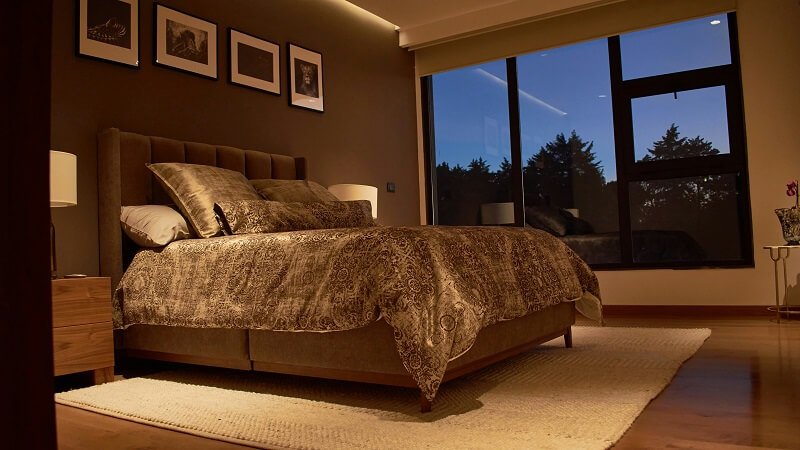
Want a bedroom that actually helps you switch off at night?
Most people spend thousands of dollars on mattresses, pillows and elegant bedding. Yet they neglect the thing that contacts their sleep every night…
The lights.
Here’s the problem:
Too much blue light keeps your mind alert long after you hit the hay. And many Americans are already operating on fumes. New CDC data reveals that 30.5% of adults slept less than seven hours per night in 2024. Nearly one in three people are waking up exhausted.
The good news? Lighting upgrades are inexpensive, easy and can really impact how you feel.
Time to jump in!
Inside This Guide:
- Setting The Tone With An Entryway Foyer Chandelier
- Why Lighting Affects Your Sleep
- 6x Bedroom Lighting Ideas That Help You Unwind
- The Lights-Out Summary
Setting The Tone With An Entryway Foyer Chandelier
A calm bedroom actually starts at your front door.
Ambient lighting. It’s what greets you when you walk in the door and sets the tone for the evening. A glaring, stark hallway bulb leaves you feeling like you need to keep thinking “go.” A warm, subdued entryway foyer chandelier speaks calmly… it’s time to stop.
Think about it:
Your eyes adapt to the brightness around them. Stepping from a sunny entryway into a dark bedroom feels drastic. If your entryway is already dim and warm though, your journey from door to bed becomes one seamless wind-down.
Select warm bulbs, a dimming option and shades that diffuse light when shopping for an entryway foyer chandelier. Shopping Lightopia chandeliers is a great way to see how different styles, sizes and finishes diffuse softness into an entryway without creating darkness. Continue that warm glow down the hall and into the bedroom.
Pretty simple, right?
Why Lighting Affects Your Sleep
Your body has an internal clock. And light is its primary setter.
Bright light signals to your brain that it is daytime. Dim yellow light signals your brain to begin shutting down. When your bedroom looks like an office at 10pm, your brain gets confused…
Mixed signals = poor sleep.
It doesn’t stop there. Exposure to light during sleep can be disruptive as well. Laboratory research has shown that exposure to just one night of room light increased study participants’ heart rate while they slept. That single night of light exposure also worsened study participants’ blood sugar regulation the following morning.
The kicker: That overhead room lighting was only about 100 lux, what most people consider normal. The women sleeping in a room with less than 3 lux had none of these problems.
If a normal ceiling light can cause this in one night… imagine what it’s doing to you day after day for years.
6x Bedroom Lighting Ideas That Help You Unwind
Alright on to the fun stuff. These concepts can be applied to any bedroom regardless of size. Choose one or two that you like and give them a try for a week and see how you like it. Truly that easy.
Layer Your Light
One overhead light is not enough. Actually… it’s usually the problem.
The best bedrooms use three layers of light:
- Ambient light: the soft, general glow that fills the room
- Task light: focused light for reading or getting dressed
- Accent light: soft light that warms up a space; think lamps or LED strips
Layering translates into never having to turn on one big bright light at night. You use whatever layer is appropriate. This allows the room to stay dimly lit and tranquil even with activity.
Go Warm, Not Cool
Bulb colour matters more than most people think.
Light colour is measured in Kelvins (K). The smaller the number, the warmer/cooler the light looks (more orange). You want bulbs around 2700K or less for a bedroom.
Cool white or “daylight” bulbs (5000K and higher) have more blue light. Wonderful for your kitchen or home office in the morning. Not so wonderful for your bedroom at night.
Tip: Look for the Kelvin rating before you purchase. Most bulbs will have the Kelvin number on the package.
Put Everything On A Dimmer
Dimmers are one of the easiest upgrades you can make.
Dimmers allow you to gradually turn down the lights as bedtime approaches. Bright enough to clean up at 8pm. Low and cozy by 10pm. Smart bulbs allow you to do this even easier — many have scheduling features that automatically dim your lights every night.
Bonus: Many smart bulbs also change colour, meaning they turn warmer as they dim.
Swap Harsh Overheads For A Soft Statement Piece
Here’s something a lot of people overlook…
The ceiling-mounted overhead fixture is usually the brightest light in the room. Exposed bulbs and flat panel fixtures cast direct glare down on the bed.
Wall sconces create downward lighting. A small chandelier or pendant with fabric shades or frosted glass diffuses light. This eliminates harsh shadows and creates a more calming atmosphere in the room. Your fixture can also tie in with your entryway for a cohesive look from door to pillow.
Add Bedside Reading Lights
Bedtime reading is a relaxing activity. Reading by the main ceiling light is not.
Have a table lamp or wall-mounted reading light by your bed on each side. Get one with a shade that directs light downward onto your book, instead of into your eyes. Swing-arm wall lights work well in smaller rooms as they save space on the nightstand.
Sleep in the same bed? Individual lights allow one person to read without waking the other. Win-win.
Get Rid Of The Little Lights
This one surprises people…
Tiny lights can mess with your sleep too. Think about:
- Standby lights on TVs and chargers
- Glowing alarm clocks
- Streetlights sneaking past the curtains
Tape over small LEDs, turn your clocks away from the bed and hang blackout curtains. In a large adult survey in Poland, 41.4% reported they already utilize blackout curtains to eliminate light at night. It’s an inexpensive solution that is effective.
Looking for a nightlight to use when you have to get up to go to the bathroom? Opt for a low light that has a cool temperature and is positioned down low near the floor. You can see your space without fully waking yourself up.
The Lights-Out Summary
Getting good sleep doesn’t always require buying a new mattress or expensive technology. Sometimes it’s as easy as switching bulbs.
To quickly recap:
- Start with a soft, warm entryway foyer chandelier to set the tone
- Layer your bedroom lighting
- Use warm bulbs around 2700K
- Add dimmers or smart bulbs
- Swap harsh overheads for softer fittings
- Get rid of the little lights
Give a few of these tips a try this week. Your body will thank you for it… even if it doesn’t seem like it immediately.