
The quiet workhorse behind American jobsite versatility
Across the United States, a single excavator rarely does a single job. On a Texas pipeline right-of-way it digs trench in the morning and drills fence-post holes in the afternoon; on a Midwest solar farm it swaps a bucket for an auger every few hours. This flexibility is the economic logic of the modern rental fleet, where one machine must justify its cost by wearing many tools.
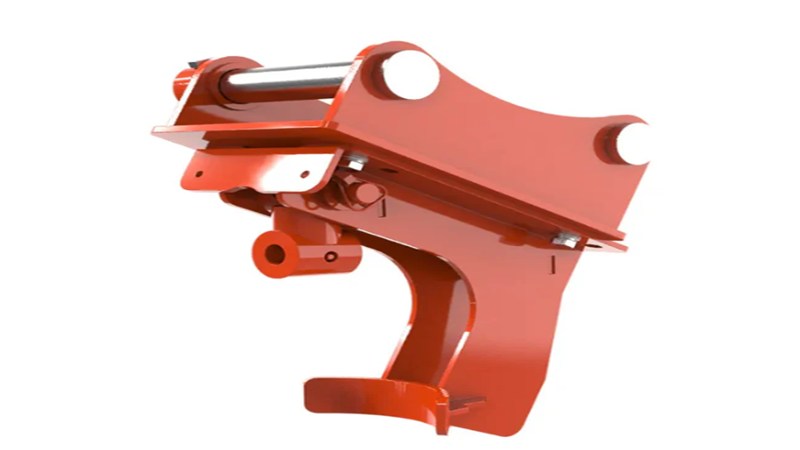
That bracket is the cradle hitch, and it deserves more attention than it usually gets, because it is the part standing between a working attachment and the ground.
Operators tend to focus on the auger or the bucket and treat the mounting as an afterthought. Yet the cradle hitch is where the forces concentrate, and where a failure is most sudden. Understanding what it carries is the difference between a tool that works for years and one that loosens, wallows, and eventually drops.
Why the mounting is the single load path
Picture the connection as the wrist of the machine. Everything the tool weighs, and everything the tool does, must pass through that wrist to reach the arm. There is no second route. When an auger drive bores into hard clay, the cutting head wants to spin, and because the soil resists, the whole drive housing wants to spin the opposite way.
So the bracket carries two distinct burdens at once. The first is dead weight, the steady downward pull of the tool. The second is reaction torque, an unsteady rotational shove that rises and falls as the bit bites and slips. A double-pin cradle hitch answers this by using two pins set apart from each other: the gap between them gives the torque a lever to push against, so each pin shares the rotational load rather than one pin fighting it alone.
How two pins divide the work
The two pins do not do identical jobs. One acts mainly as the hinge the tool hangs from, taking the bulk of the vertical weight. The other works as the anchor that resists rotation, absorbing most of the twisting moment. Because they sit at a distance, the torque becomes a push-and-pull couple across the pair, and each pin sees a manageable share instead of an overload.
This is why pin fit governs safety more than almost any published number. A pin that fits its bore snugly carries load across its full cross-section in shear, the strongest way steel resists a sideways force. A worn pin rattles in an oversized hole, and every cycle of the drill delivers a small hammer blow to the edges. Over weeks the bore elongates and the load that was meant to spread across a tight fit now slams against a thin lip of metal.
- Snug pins share load in clean shear
- Loose pins pound the bore into an oval
- Elongated bores accelerate their own wear
Reading the trade-off two ways: pin-on versus quick coupler
Mounting methods fall into two families, classified by how the tool is secured. A direct pin-on cradle hitch fastens the attachment with pins driven and retained by hand. A quick coupler adds a powered or lever mechanism that grabs the tool without an operator leaving the cab. The same trade-off can be read in two opposite ways depending on what the job values.
Read for rigidity and economy, the direct pin-on connection wins. With fewer moving parts between the tool and the arm, there is less play to develop and less to inspect. Read for speed and operator safety, the quick coupler wins, because changing tools without anyone stepping into the swing zone removes both downtime and a pinch-point hazard.
What inspection actually protects against
Because the connection is the sole load path, inspection of the cradle hitch is not housekeeping but the core of safe operation. The signs of trouble are mechanical and visible. When operators rock the tool, movement at the joint, bright metal smeared around a pin, or a bore that has gone from round to oval all point to the same conclusion: the fit is failing, and the joint is concentrating the load where it should not.
- Check for play before each shift
- Look for elongated or oval bores
- Confirm pins and retainers are seated
When operators treat the cradle hitch as the structural heart of the attachment rather than a simple bracket, it rewards that attention with years of dependable, safe service as part of reliable attachment mounting solutions across every tool the machine carries.
The lesson for any equipment manager is that versatility and safety come together at the same small assembly, where pins fit properly, share the load, and technicians check them before they trust them.