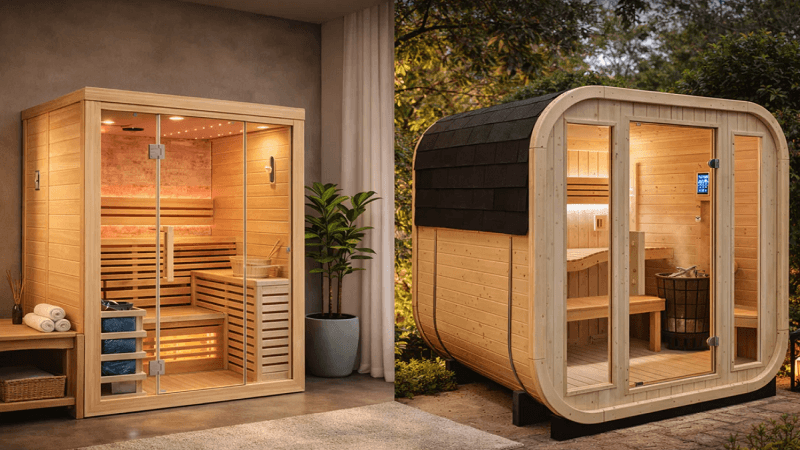
The home sauna has moved from a niche purchase associated with high-end properties to a practical consideration for a much wider range of homeowners. Falling installation costs, a broader product range at varying price points, and a substantial shift in how people think about personal wellness at home have all contributed to this change. For homeowners thinking about adding a sauna to their property, the market now offers more options than ever, but understanding those options well enough to make a confident decision requires some knowledge of how saunas work, what the main product categories involve, and what installation actually requires.
The case for owning a home sauna rests primarily on the documented health benefits of regular heat exposure. These are not anecdotal. The cardiovascular, muscular, and neurological effects of sauna use have been studied in clinical settings across several decades, and the consensus in the research literature is that consistent use, several sessions per week over months and years, produces measurable improvements in cardiovascular health, muscle recovery after exercise, quality of sleep, and stress-related physiological markers. The key word is consistent. Occasional visits to a commercial sauna deliver some benefit, but the research supporting the most significant outcomes refers to regular and sustained practice, which is most practically achieved when a sauna is accessible at home.
Traditional Versus Infrared: Understanding the Difference
The two main categories of home sauna differ fundamentally in how they deliver heat, and understanding this difference is the first step in choosing the right format.
A traditional Finnish sauna heats the air in an enclosed wooden room using a stove, typically loaded with rocks. The stove raises the ambient temperature to between 70 and 100 degrees Celsius. When water is poured over the heated rocks, it produces steam, creating a burst of intense humid heat known in Finnish as loyly. Sessions in a traditional sauna typically involve alternating between periods of high heat and cooling breaks, either in cool air or under a cold shower. The experience is intense, immersive, and deeply connected to the wellness traditions it draws from.
An infrared sauna operates on a completely different principle. Instead of heating the air around the body, infrared panels emit radiant heat that penetrates the skin and warms the body from within. The ambient temperature in an infrared cabin is considerably lower, typically between 40 and 60 degrees Celsius. Because the heat works at the tissue level rather than through hot air, users often find that they begin sweating at lower temperatures and that the experience feels more comfortable, particularly during the first few sessions. Infrared saunas also heat faster than traditional models and require less electrical power.
Both formats deliver meaningful health benefits, and the choice between them is largely personal. Users who want the authentic traditional experience, including the steam and the high-heat environment, will prefer the traditional format. Users who prioritise ease of entry into sauna use, lower operating temperatures, and compact installation requirements often find infrared more practical for domestic settings.
Choosing the Right Sauna for Your Home
Retailers like Insignia Showers offer a range of home sauna options covering both traditional and infrared formats at different sizes and specifications, which makes it practical to explore the options available across both categories before committing to a purchase.
The key variables to consider in the selection process are the number of users the sauna needs to accommodate, the space available for installation, the power supply situation, and the preferred heat experience. A one-to-two person cabin requires significantly less floor area than a family unit and can typically fit into spaces that homeowners would not initially consider viable. Infrared units in particular can be accommodated in spare rooms, large walk-in wardrobes, garage annexes, and garden rooms that a traditional sauna’s ventilation requirements might rule out.
Budget also varies considerably across the market. Entry-level infrared cabins are available at price points accessible to a broad range of homeowners. Premium traditional saunas with high-grade timber construction, commercial-specification stoves, and bespoke sizing are a materially different investment. Understanding where on this spectrum the right purchase sits requires honest assessment of how frequently the sauna will be used and by how many people, because the cost-per-session calculation changes significantly with frequency of use.
Installation Requirements
Home sauna installation is considerably less involved than most first-time buyers expect. The majority of infrared sauna cabins are delivered as flat-pack structures that can be assembled by two people in a few hours without specialist tools. The only essential utility requirement is an appropriate electrical connection, and for most domestic infrared units this means a standard 13-amp socket is sufficient.
Traditional saunas require a higher-powered electrical supply for the stove, typically between 4 and 9 kilowatts depending on the size of the room. They also require adequate ventilation to allow fresh air to enter the cabin and moist air to exit, which affects where they can be positioned within a property. Outdoor sauna structures avoid the ventilation complexity of indoor installation and are increasingly popular as garden buildings, though they require a weather-appropriate power supply connection and a level, stable base.
Planning permission is not typically required for a domestic sauna installation in the UK, whether indoors or as a garden structure, though garden buildings above certain dimensions or located in conservation areas may require checking with the local planning authority.
Maintenance and Ongoing Care
Wooden sauna cabins require occasional maintenance to remain in good condition. Cleaning the interior surfaces periodically, inspecting the stove or infrared panels for any operational issues, and treating exterior timber on outdoor structures to maintain weather resistance are the main tasks. Interior timber generally does not need sealing or oiling, as the heat and humidity of regular use maintain the wood naturally and sealants can be harmful when heated.
The stove in a traditional sauna requires periodic cleaning and inspection of the rocks, which lose their heat retention capacity over time and benefit from replacement every few years. Infrared panels are generally maintenance-free over the operational life of the unit.
Frequently Asked Questions
How often should I use a home sauna to experience health benefits?
Research supporting the most significant health outcomes, particularly cardiovascular and sleep quality benefits, refers to regular use of three to seven sessions per week. Even two to three sessions per week produces meaningful benefits over time. Having access at home is the most reliable way to achieve and maintain this frequency.
What temperature should a home sauna be set to for beginners?
For traditional saunas, starting at around 70 to 75 degrees Celsius is a comfortable entry point. For infrared saunas, 45 to 50 degrees Celsius is a typical starting range. Session length for beginners should be kept to ten to fifteen minutes initially, with longer sessions as the body adapts to the heat.
Can a home sauna be installed in a flat or apartment?
An infrared sauna can theoretically be installed anywhere with sufficient floor space and electrical access, but in a flat or apartment, checking with the building’s management or freeholder about structural loads and ventilation implications is advisable before purchase.
Is a traditional sauna or an infrared sauna better for muscle recovery?
Both deliver heat to muscle tissue and support the circulatory and relaxation responses associated with recovery. Traditional saunas achieve this through air heat and the option of steam, while infrared delivers heat directly to tissue at lower ambient temperatures. Many athletes prefer traditional saunas for the intensity of the experience; many regular users prefer infrared for comfort and consistency. Both produce meaningful recovery benefits.
Does a home sauna add value to a property?
A well-installed home sauna in good condition is an attractive feature to buyers who prioritise wellness, and in the current market where home wellness spaces are increasingly sought after, it can contribute positively to a property’s appeal. The extent to which it adds measurable value depends on the local market and buyer profile.