
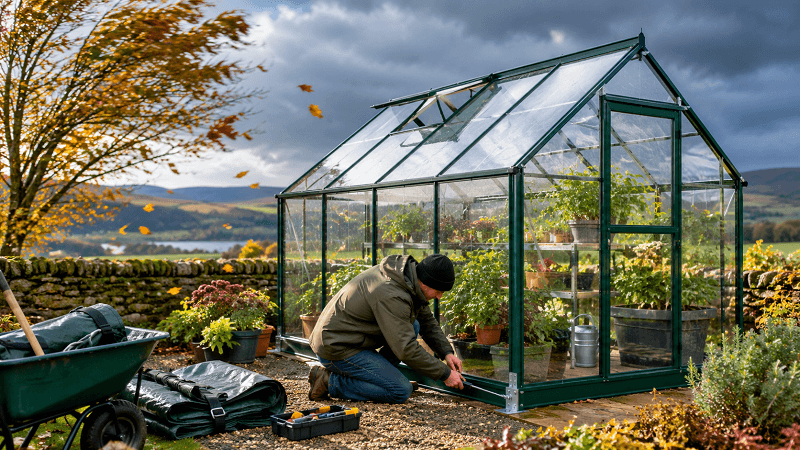
Anyone who’s grown tomatoes through a Welsh summer knows the weather doesn’t wait for you to be ready. One morning your greenhouse is standing fine, and by teatime a gust off the Brecon Beacons has popped a pane and scattered your seed trays across the allotment.
Autumn is when that risk jumps up sharply, and the Met Office seasonal outlook has already flagged an active Atlantic storm track heading into this winter. The fixes aren’t complicated, and most of them won’t cost you more than an afternoon and a few quid in clips and bolts. Here’s what to sort before the first named storm hits.
Check Your Anchoring First
Without proper anchoring, your greenhouse will catch wind like a kite. If yours sits on a base frame bolted to a concrete pad, go out and check every single bolt. Corrosion loosens them slowly, sometimes over just one winter, and a single missing fixing can let the whole structure lift when a proper gust comes through. Greenhouses sitting on bare soil need screw-in ground anchors, which are cheap and dead easy to fit. Drive them in at each corner and along the base rails, paying extra attention to the side that faces the prevailing westerlies.
Allotments in Pembrokeshire or Gwynedd tend to sit on more exposed ground, so you’ll want to go further. Run galvanised wire over the roof ridge and peg it into the ground on both sides. It won’t win any beauty contests, but it’ll keep the frame where it belongs when the wind picks up in November.
Glazing Clips and Loose Panes
Nobody thinks about glazing clips until one fails and a pane goes flying. They’re tiny. They rust. And when they let go, that pane turns into a projectile heading for your cold frame or your neighbour’s shed. Walk the whole structure and press each pane gently. If it rattles or moves at all, the clips need swapping out. W-clips and Z-clips for standard aluminium frames are stocked at most garden centres, and they’ll set you back almost nothing.
Check for cracked panes too, because a hairline crack that holds through a calm week won’t survive a named storm blowing in off the Irish Sea.
Swap Your Most Exposed Panes
Too many growers only think about replacing glass after a storm has already put it through. That’s backwards. The panels that cop the worst punishment will almost always be the ones facing south-west, directly into the prevailing wind, and traditional horticultural glass shatters on impact. Cleaning up broken glass from between your raised beds is nobody’s idea of a good Saturday.
A high-quality, clear acrylic sheet cut to size will flex under pressure instead of shattering, and it transmits roughly the same amount of light as glass. It’s about half the weight as well, which means less strain on the frame over time. You don’t need to replace every pane in the greenhouse. Just target the ones that face the worst of the weather or the ones already showing cracks and wear.
Clear the Gutters and Downpipes
Blocked gutters cause more damage than most people realise, because when water backs up and pools against the frame, corrosion on aluminium and rot on timber will both accelerate fast. Autumn leaves can clog a greenhouse gutter in a matter of days, so don’t assume last month’s clear-out still counts.
Run a hand along the channels, pull out the debris, and flush the downpipes with a hose. If your gutters drain into a water butt, check that the butt has an overflow pipe fitted. A full butt with no overflow will push water back up into the gutter and right against the frame joints, which is exactly the kind of slow damage you won’t notice until spring.
Plant a Wind Break
Storms will always come, but a row of hardy shrubs on the windward side of your greenhouse can cut wind speed and turbulence down considerably before it reaches the frame. Hawthorn, escallonia, olearia and griselinia all handle Welsh conditions well, and they’ll tolerate salt air if you’re gardening near the coast.
Keep them at least two metres from the greenhouse so the roots don’t interfere with your base. They’ll need a season or two to establish properly, so get them in the ground this autumn if you want real protection by next winter.
Don’t Wait for Storm Gerrit
Named storms in Wales tend to roll in from late October through February, and the worst structural damage almost always happens to greenhouses nobody bothered to check beforehand.
An afternoon spent tightening bolts, swapping out a few clips, and fitting acrylic over the most exposed panes will save you weeks of repair work and a lot of frustration come January. Sort it now, while the weather’s still on your side.