
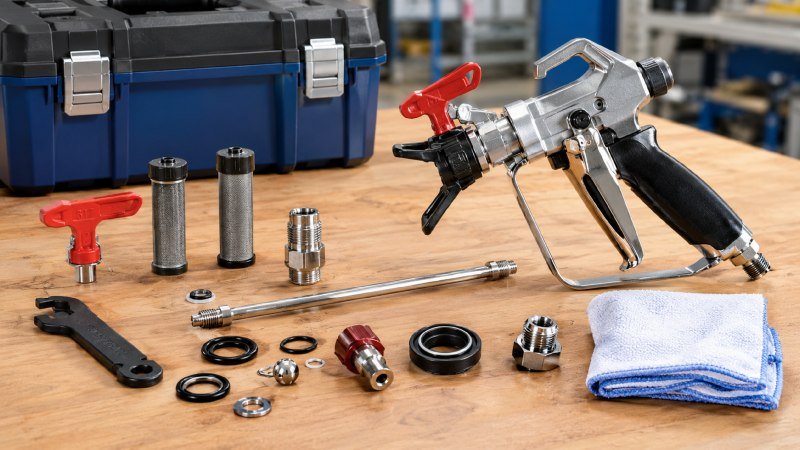
Once an S-7 spray gun needs its first round of parts, most contractors hit the same fork in the road: pay more for genuine S-7 parts or save money on aftermarket components that claim to fit. The decision matters more than it might seem, and it is worth understanding what you are actually choosing between before you order.
What OEM Parts Actually Guarantee
Genuine Titan parts for the S-7 are manufactured to the exact tolerances the gun was originally designed around, which matters most in the components that control sealing and pressure. A seal assembly that is a fraction of a millimeter off in dimension might still physically fit, but it can compress differently under pressure, leading to leaks or inconsistent performance that only shows up after the part has been in service for a while, not immediately when you install it.
OEM parts also come with a clear chain of accountability. If a genuine part fails prematurely, there is a manufacturer and a documented specification behind it. Aftermarket parts, particularly ones sourced from unfamiliar suppliers, often do not carry that same level of quality control, and it can be genuinely difficult to tell a well made aftermarket part from a poorly made one just by looking at it.
Where Aftermarket Parts Can Make Sense
To be fair, not every component on the gun is equally critical. Basic hardware like screws, washers, and simple mechanical fasteners are less likely to cause a real problem if sourced from a quality aftermarket supplier, since the tolerances that matter for those parts are far less precise than what is needed for sealing components under pressure.
If budget is a real constraint and you are working on non critical hardware, a reputable aftermarket source can be a reasonable compromise. The key word there is reputable. A part with no clear manufacturer, no fitment documentation, and a price that seems too good to be true is a real risk regardless of what category of component it is.
The Parts Where OEM Matters Most
For anything involving seals, the trigger and lock assembly, or components that directly contact pressurized material, the case for OEM is much stronger. These are the parts where a small dimensional difference translates directly into a leak, a pressure inconsistency, or a part that fails well before it should. The cost difference between OEM and aftermarket on these specific components is usually small in absolute dollar terms anyway, which makes the aftermarket savings hard to justify given the risk.
Fitment is the other issue that comes up constantly with aftermarket seal and trigger components. Even parts marketed as a direct fit for the S-7 sometimes require minor modification or do not seat quite correctly, which can cause a leak that is difficult to diagnose because the part looks correct and appears installed properly.
How the S-7 Compares to the S-3 on Parts Availability
The S-7 shares a family resemblance with the S-3 spray gun in Titan’s lineup, and while the two guns are not identical, understanding that relationship helps when you are researching parts. Both benefit from being part of a well established platform with a deep, consistently stocked parts catalog, which is a real advantage over choosing a less common gun where a single supplier interruption could leave you waiting weeks for a critical seal or trigger component.
That established supply chain is itself a form of insurance most buyers do not think to factor into an OEM versus aftermarket decision. A part that is always in stock somewhere is worth more than a marginally cheaper part that might not be available when you actually need it.
The Real Cost Comparison
When contractors compare OEM and aftermarket purely on sticker price, OEM usually looks like the more expensive option. That comparison misses the full picture. A cheap seal assembly that needs replacing again in a third of the time an OEM part would last is not actually saving money, especially once you factor in the labor time spent reinstalling it and the potential for a leak to damage other components before it is caught.
Downtime is the other cost that rarely makes it into the comparison. A gun that fails mid-job because of a low quality aftermarket part costs you production time that a slightly more expensive OEM part would have avoided. For a contractor running the gun daily, that lost time adds up to real money far faster than the price difference between OEM and aftermarket parts ever would.
Building a Relationship With a Trusted Supplier
That relationship becomes especially valuable the first time a part is genuinely backordered everywhere, since a supplier who knows your operation is far more likely to help you find a workable substitute or an honest timeline than a purely transactional seller would.
Over time, the single best way to simplify the OEM versus aftermarket decision is building a relationship with a supplier you trust to steer you correctly on both categories. A knowledgeable parts supplier will tell you honestly when a cheaper alternative is fine and when it genuinely is not, rather than pushing the highest margin option regardless of whether it is the right call for that specific component. That kind of straight guidance, over dozens of orders across a season, is worth more than chasing the lowest price on every individual purchase.
A Practical Buying Checklist
Before placing an order for S-7 parts, it helps to run through a short checklist: confirm the exact part number against your gun’s specific model, verify the seller is an authorized dealer rather than an unverified third party marketplace listing, and check that the component category, sealing versus structural, matches the OEM versus aftermarket guidance above.
Following that checklist consistently, rather than shopping purely on price for every single order, keeps the gun performing reliably while still giving you room to save money on the hardware components where the risk of cutting corners is genuinely low.
Making the Call
For critical sealing and trigger components on the S-7, genuine parts are worth the price difference in almost every situation, because the failure modes for a poorly made aftermarket part in those spots are expensive in ways that go beyond the part’s cost. For simple hardware and fasteners, a reputable aftermarket supplier can be a reasonable way to save money without meaningfully increasing your risk.
The simplest rule of thumb: if the part touches pressurized material or controls the seal, buy OEM. If it is structural hardware that just holds things together, aftermarket from a trustworthy source is a fair trade off. Knowing which category a given part falls into before you order saves both money and headaches down the line.
Final Thoughts on Getting This Right
None of this needs to be complicated once you have the basic framework in mind. Genuine parts where sealing and pressure are involved, a trusted aftermarket option where simple hardware is concerned, and a supplier relationship that helps you tell the difference when you are not sure. That approach keeps the S-7 performing reliably without paying a premium on every single component regardless of whether that premium is actually buying you anything.
About the Author
Nnanna Otuonye is the founder and CEO of AllTitanParts.com, an authorized OEM parts dealer for Titan, SprayTech, Wagner, and Speeflo sprayer equipment, based at 5250 Gulfton St, Suite 1H, Houston, Texas. With more than 20 years in the spray equipment industry, he has helped thousands of contractors source the right parts, troubleshoot equipment problems, and keep their airless sprayers running through genuine OEM components and same-day shipping.