
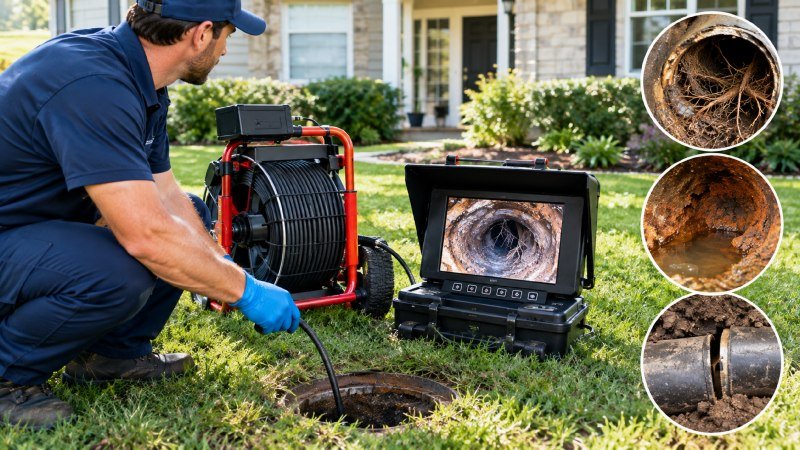
Ask any home inspector what they wish buyers understood and the sewer line is near the top of the list. It is the most expensive single plumbing component in a house, it is completely invisible, and the standard inspection does not look inside it. Buyers spend an hour on the roof and the attic and two minutes on the pipe that will cost them the most if it fails. Here are the five things inspectors would say if they had the buyer’s full attention, and what to do about each during the option period.
1. The general inspection does not see the sewer
A home inspection checks that drains drain. The inspector runs water, watches it go, and reports “functional.” A sewer line with roots through half its diameter is functional on inspection day and blocked the first time the new owners host a dinner. The only way to see the inside of the lateral, the pipe from the house to the street, is a camera, and a camera is a separate service that has to be ordered.
Inspectors say this in their reports, usually in a line recommending “further evaluation by a licensed plumber.” Buyers read it as boilerplate. It is the most important sentence in the plumbing section.
2. The age of the house tells you what the pipe is made of
Sewer laterals in the Houston area follow the decades, because builders used the same materials across whole subdivisions at the same time.
| Era | Under the slab | To the street | What goes wrong |
| Before 1960 | Cast iron | Clay in short sections | Cast iron channels and collapses; roots enter every clay joint |
| 1960 to 1975 | Cast iron | Clay or cast iron | Same failures, 50 to 65 years on |
| 1975 to 1990 | PVC or late cast iron | PVC or Orangeburg in a few areas | Mostly sound; bellies from clay soil movement |
| 1990 onward | PVC | PVC | Sound unless a joint has shifted or a contractor cut it |
Cast iron rusts from the inside: the bottom of the pipe channels, the walls scale, and eventually a section collapses. Clay is laid in two- or three-foot sections, and every joint is an opening for roots, which follow the moisture and grow into a mat. PVC has none of those problems but can sag where Houston’s clay soil has moved, leaving a belly that holds water and solids.
So a 1960s house in Meyerland, Bellaire, Oak Forest or the Heights, with mature trees in the yard, has a sewer line that needs to be looked at before anyone signs. A 2005 house in Katy probably does not, unless the drains are already showing symptoms.
3. The camera is the inspection
A sewer scope pushes a camera on a stiff cable through the lateral from a cleanout, or from a pulled toilet if there is no cleanout, and records the inside of the pipe to the city connection. The head carries a transmitter, so a locator above ground finds the exact spot and depth of anything it sees, and a footage counter marks the distance.
| What the camera finds | What it looks like on screen | What it means |
| Roots | Fine hairs at a joint, or a curtain across the pipe | Open joints; jetting buys time, repair fixes it |
| Scale and channelling | A rough, rust-colored wall; a groove along the bottom | Cast iron near the end of its life |
| Belly | The lens goes under standing water for several feet | A sag; solids collect; recurring backups |
| Offset joint | A lip the camera bumps over | Soil movement; catches everything |
| Crack or break | A line in the wall; soil visible through it | Leaking into the ground; roots next |
| Collapse | The camera cannot pass | The section must be replaced |
| Grease or debris | Diameter visibly reduced | Cleaning, then a second look |
The result is a video and a plain-language summary with distances. For a buyer that is the difference between a vague worry and a number. A sewer camera inspection in Houston takes about an hour, and the recording is a document the buyer can take to the negotiation. If the line is backed up or full of debris, it is cleared first so the wall is visible; if the seller offers to have it cleaned before the scope, scope it after the cleaning, when the pipe wall can actually be seen.
Inspectors see buyers skip the scope to save a small fee and then pay for a full sewer replacement in year one more often than anyone would like.
4. The signs the seller might not mention
Some things show without a camera, if you know to look:
- Mature trees between the house and the street, especially live oaks, willows and anything with aggressive roots.
- No cleanout anywhere outside the house, which usually means the line has never been cleaned from outside and probably never inspected.
- A patch of lawn that is greener or softer than the rest, on the line between the house and the street.
- Gurgling from a toilet when another fixture drains, or a ground-floor tub that fills with water on its own.
- A bottle of enzyme or chemical drain cleaner under every sink, which says the seller has been managing something.
- A disclosure or a receipt that mentions “drain cleaning” as routine maintenance. Routine cabling is a symptom.
- A toilet that rocks, which has usually been leaking under the floor for months and sometimes points to a flange on a failing cast iron drain.
None of these is proof. All of them are reasons to order the camera.
5. A bad scope is not the end of the deal
Buyers hear “roots in the sewer line” and picture a yard dug up. Sometimes that is the repair. More often the options are better than they expect, and the camera footage decides which applies.
| What the scope found | Usual fix | Disruption |
| Roots at one or two joints, pipe otherwise sound | Jetting now, then jetting on a schedule, or a spot repair of the open joint | Minimal |
| Grease or scale lining in a sound pipe | Hydro jetting | None |
| One broken or collapsed section | Spot repair: dig to that section, replace it | A small excavation at the marked spot |
| Many failed joints, cracks along the run, roots throughout | Trenchless relining: a resin liner cured inside the old pipe | One access pit; driveway and trees stay |
| Belly or wrong slope | Excavation and re-laying of that section at the correct fall | A trench along the sag |
| Collapsed under the slab | Tunnel under the foundation or open the floor | Significant, but localized to the footage mark |
A sewer line repair priced from the footage replaces only what has failed; a quote made without a camera has to assume the worst. For a line that has failed at many joints but is still round and in place, trenchless sewer repair cures a new pipe inside the old one from a single access point and leaves the driveway and the trees alone, which is why it is the common answer in older Houston neighborhoods with big oaks over the lateral. Each option has a price that goes into the negotiation as a credit, a repair before closing, or a reduction.
What the scope prevents is the surprise. The buyer who knows the line needs relining in the next few years can plan for it, or price it. The buyer who finds out at a dinner party cannot.
What to do during the option period
- Order the camera inspection on any house built before 1980, any house with large trees over the lateral, and any house with the signs above.
- Ask for the video file, not just the summary, and keep it with the house records.
- If the line is cleaned before the scope, scope it after the cleaning so the pipe wall is visible.
- Get a written repair quote from a plumber you would actually hire for anything the video shows, before the option period ends.
- Put the number in the negotiation as a credit rather than a seller-managed repair, so you choose the contractor and own the result.
Three questions buyers ask
How much does a sewer scope cost? A few hundred dollars for a typical house with a cleanout, more if the camera has to go through a roof vent or a pulled toilet. Against a repair that runs into the thousands, it is the cheapest plumbing decision in the purchase.
What if the seller refuses access? Sellers rarely refuse a non-invasive inspection during the option period. A refusal is itself information.
Can the city’s line be the problem? Yes. A two-way cleanout at the property line lets the camera look toward the city main and show where a blockage is; that footage is what the City of Houston asks for before it responds. A house without any cleanout should have one added, and that can also go in the negotiation.
From the trade
Royal Flush Affordable Plumbing, a Houston plumbing company that runs sewer cameras for buyers, sellers and homeowners across the city, hears the same question from every buyer after a bad result: why did nobody tell me to do this? The inspectors did, in the line about further evaluation. The buyers who read that line as an instruction, not a disclaimer, are the ones who never have to make the phone call.