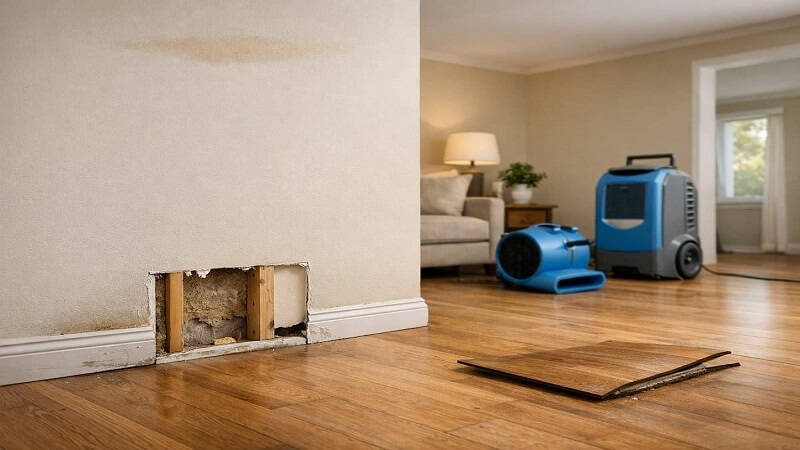
It is a scenario played out in countless homes: a pipe leaks, a bucket is placed under the drip, and the homeowner immediately rounds up every floor fan and space heater in the house. Windows are opened, the carpet is blotted, and within a day or two, the surface feels dry to the touch. The assumption is that the problem is solved and the danger has passed.
However, within weeks, a faint musty odor begins to linger, or a baseboard starts to pull away from the wall. The core misconception here is that drying is a visible process. In reality, while drying is a necessary step, it is often just the surface-level beginning of a much deeper restorative process.
Insight: Most long-term water damage problems do not stem from what stays wet, but from what appears dry too soon.
What Drying Actually Does (And What It Doesn’t)
Surface-Level vs. Structural Reality
Drying is the act of removing visible moisture from the surface of your home’s components. While this is essential to stop immediate pools of water, it rarely addresses the structural reality of the building.
- Trapped Water: Moisture often remains trapped inside wall cavities long after the drywall feels dry.
- Saturated Insulation: Materials like fiberglass or cellulose insulation act like sponges, holding water against wooden studs.
- Subfloor Moisture: Water easily seeps through floorboard cracks, saturating the subfloor where airflow cannot reach.
Insight: A surface can feel bone-dry while internal moisture levels remain high enough to cause silent, ongoing deterioration.
The Hidden Journey of Water Inside a Home
Where Moisture Travels After the Leak Stops
Water is dynamic. Once it escapes its containment, it follows a predictable yet destructive path through your home’s materials.
Through capillary action, water is pulled upward and laterally into porous materials like a wick. It does not just sit on the floor; it climbs up the back of your drywall and deep into the pores of wooden framing. Furthermore, your HVAC system can pull humid air from the affected area and circulate it throughout the house, leading to secondary condensation in rooms that were never even touched by the initial leak.
Insight: Water damage is rarely confined to the area where the leak actually occurred; it is a traveling force.
Why Time Matters More Than Most People Think
The 24–72 Hour Turning Point
The timeline of water damage is exponential. The longer moisture sits, the more the repair bill grows.
- First 24 Hours: Moisture is generally manageable, and materials are mostly salvageable.
- 24–48 Hours: Chemical breakdowns begin. Wood starts to swell, and metal surfaces may begin to tarnish.
- 48–72 Hours: This is the biological threshold. Mold spores, which are always present in the air, find the moisture they need to begin colonizing.
Insight: The timeline of water damage is not linear. Waiting an extra day can triple the complexity of the repair.
The Difference Between Drying and Restoration
Two Processes People Confuse
It is helpful to view these as two distinct stages of a recovery plan. Drying is the removal of moisture. Restoration is the process of returning the structure and its materials to their pre-damage condition.
Restoration often requires more than just airflow. It may include the surgical removal of unsalvageable materials (like saturated carpet padding), decontamination to prevent bacterial growth, and structural repairs to wooden framing that has lost its load-bearing strength. Drying alone cannot reverse the warping or rot that has already taken place.
Insight: Drying stops the situation from worsening, but it does not magically undo the damage that has already occurred.
The Risks of Stopping at “Dry Enough”
When Problems Resurface Later
Stopping the mitigation process the moment the carpet feels dry often leads to “secondary damage.” This is damage caused not by the initial splash of water, but by the lingering humidity left behind. You may see paint begin to bubble, drywall tape peel away, or notice a persistent musty odor that air fresheners cannot mask. These are all signs of incomplete mitigation.
Insight: Most secondary damage is not caused by the water itself, but by an incomplete drying process that left hidden pockets of moisture.
Why DIY Drying Often Falls Short
The Limits of Fans and Dehumidifiers
Household equipment is designed for comfort, not for deep structural drying. A standard pedestal fan lacks the static pressure required to force air through wall cavities or underneath flooring.
Moreover, homeowners often lack moisture measurement tools, such as infrared cameras or hygrometers, to confirm that the internal “bones” of the house are actually dry. Without these tools, deciding when the area is dry is simply a guess.
Insight: Without scientific measurement, “dry” is just an optimistic guess.
When Drying Needs to Become Restoration
Recognizing the Turning Point
There is a clear line where a “dry-out” must transition into a full restoration project. If you notice persistent odors, visible swelling of wood, or any discoloration on the walls, the moisture has already altered the material’s integrity.
In more complex cases, property owners often reference experienced providers like DeVry Property Restoration when discussing how deeper structural drying and repair differ from basic surface drying. Professional intervention ensures that the structural drying is verified by data, not just by touch.
Insight: The shift from a simple drying task to a major restoration project often happens quietly before a homeowner ever realizes it.
A Smarter Way to Think About Water Damage
Moving Beyond the Surface-Level Mindset
To protect your home, you have to view water damage as a process rather than a single event. True resolution requires an understanding of how moisture moves through different materials (like the difference between how tile and drywall react). The goal is not to make things feel dry, but to ensure they are structurally sound and biologically safe for the long term.
Conclusion: Dry Isn’t the Finish Line
Dryness does not equal recovery. Some of the most costly issues in home ownership come from stopping a mitigation project too early because the visible water is gone. What you cannot see after water damage is almost always more important than what you can see.
If you want to protect your investment and your health, look past the surface and ensure the job is finished properly. For homeowners who have experienced significant intrusion and need professional intervention to ensure the structure is truly sound, securing expert Water Damage Restoration Services in Glendale is the final step in ensuring your home returns to a safe, pre-loss condition.